
Curriculum & Philosophy
The Montessori Developmental Planes

Montessori education is grounded in Dr. Maria Montessori's concept of four distinct Developmental Planes, each representing a critical stage of growth. These planes guide the curriculum, environment, and teaching approach to meet the unique needs of children at every stage.
-
First Plane (0-6 years): The Absorbent Mind
This is a period of intense sensory exploration and foundational development. Children absorb knowledge effortlessly from their environment, building skills in language, movement, and independence. The focus is on creating a nurturing space where curiosity and self-discovery thrive.
-
Second Plane (6-12 years): The Reasoning Mind
At this stage, children transition from concrete to abstract thinking. They develop a thirst for knowledge about the world, driven by imagination and reasoning. Collaborative learning and exploration of moral concepts are emphasized, fostering social and intellectual growth.
-
Third Plane (12-18 years): The Social Self
Adolescents experience significant physical and emotional changes as they seek to understand their place in the world. The focus shifts to self-expression, critical thinking, and real-world experiences. Montessori environments for this stage encourage independence, community engagement, and practical skills.
-
Fourth Plane (18-24 years): The Mature Self
Young adults work toward self-actualization and independence. This stage emphasizes higher education, career exploration, and the pursuit of personal passions. The goal is to support individuals as they integrate into society with confidence and purpose.
Each plane builds upon the previous one, offering a holistic and developmental approach to education that nurtures the whole child—academically, emotionally, and socially. Montessori's vision ensures that children grow into well-rounded, capable individuals prepared for the challenges and opportunities of life.
Three core elements of the Montessori triangle
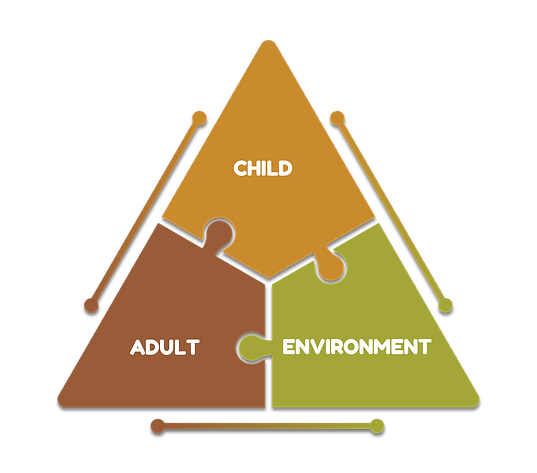
In Montessori, the three triangles—Child, Adult/Parent, and Environment—represent the interconnected elements essential for a child's development. The Child is at the center, learning through exploration. The Adult/Parent supports and guides, providing encouragement and structure. The Environment is carefully prepared to offer stimulating, age-appropriate materials that promote independence and discovery. Together, these three elements create a balanced system for nurturing a child's growth, fostering autonomy, and cultivating a lifelong love of learning.
How do you know it is a Montessori school?
.jpg)
About Montessori Schools
How do you know this is a montessori school?
"Montessori " is used as a generic term for institutional spaces created for very young children.So its important for us to know the key aspects of a montessori schools which helps a child grow.Discover how Montessori Education can transform your child.

Mixed age group

Prepared environment

Freedom and discipline

Trained adult

Montessori materials
Montessori curriculum
The Montessori curriculum focuses on five main areas: Practical Life, Sensorial, Mathematics, Language, and Culture. Each learning area uses special Montessori materials that help children learn important skills and concepts. Through repetition children get a strong understanding of each area and build key skills as they go.Montessori environments encourage children to engage with materials that promote creativity and critical thinking, allowing them to solve problems in their own way. The curriculum is designed to respect each child's individual pace and interests, providing opportunities for meaningful, self-directed learning. Outdoor exploration, as a key part of Montessori, nurtures a deep connection with the natural world, supporting sensory development and a sense of responsibility toward the environment. Through these experiences, children develop the skills to think critically, express themselves creatively, and approach challenges with confidence.